

 Some lucky people get to fly in their dreams. Often the dream starts as running, with longer and longer strides, until finally the dreamer’s feet don’t touch the ground anymore. For some of us, we get to do that in waking life: run until our feet don’t touch the ground. In many ways, flying hang gliders is just that simple. And simplicity is a big part of what it’s all about.
When the Rogallos created the first flexible wing in 1948, their aim was to make flying less complicated, less expensive, and accessible to everyone. They eventually succeeded. Many early Rogallo-style hang gliders were homemade, and some early kits were incredibly inexpensive, with instructions showing how to build the wing on one side of a sheet of paper and how to fly it on the other. Hang gliders have evolved from those early designs into sophisticated flying machines, stable aircraft designed to flex and twist in reliable, predictable ways. Pilots regularly soar hang gliders to incredible heights in thermals, and cross country flights are measured in the hundreds of miles. Instruction is now professional and consistent. Still, hang gliding remains the best kept secret in aviation.
The roots of how we fly are in that simple dream: run, taking longer and longer strides, until your feet leave the ground. When Gertrude and Rog couldn’t get any professional interest in their invention for “practical” applications, they marketed the wing as a kite, but Rog saw the possibilities from day one. In an article in 1949, he wrote, “Imagine the thrill of carrying such a glider in your knapsack to the top of a hill or mountain, and then unfurling it and gliding down into the valley below.”
Last year I flew Jockey’s Ridge with friends on a light east day. Not even close to soarable, a few of us were on the hill to help one of our elder statesmen in the sport get a few flights. We took turns flying and helping him carry the glider back up the hill, and flew a bit ourselves. The best flight possible that day was a simple pass along the face, one turn back into where lift might have been on a stronger day, and another turn back into the wind. As I waited at the bottom, I watched an old friend fly the two possible turns, land, and expertly perch the glider on his shoulders to carry it back up the hill. His fluid movements, both in flight and on the ground betrayed years of experience and muscle memory. Here’s a guy who has flown at the pinnacle of the sport–an excellent dune pilot, cross-country and aerobatics pilot, tandem instructor, tug pilot. He looked at me with a contagious smile as he carried the glider effortlessly past, and yelled, “That was FUN!”
I saw in the eyes and smile of an old friend that afternoon what Rog knew intuitively in 1949. Even with the experiences and adventures of a lifetime spent flying high and far, simply running off the hill and “gliding into the valley below” is still exhilirating–an experience like no other. Run, with longer and longer strides, until your feet no longer touch the ground.
Imagine the thrill.

 Francis Rogallo was born on this day in “19 and 12” as they used to say, and while I can’t speak authoritatively about all of his birthday celebrations, I know an important one was in 1974. Just a few years after his retirement from NASA, when hang gliding as a sport was truly taking off, Rog was invited for his birthday to what was supposed to be the “First Annual Rogallo Meet” at Escape Country, a premier hang gliding site near Trabuco Canyon, Ca.
 Sunday, August 15th, 1948, Francis and Gertrude Rogallo took their prototype flexible wing out to the field at Merrimac Shores in Hampton, VA to see how it might fly. Their first successful flexible wing kite was made from some chintz curtains that had hung as a cabinet skirt in their new house. The old pattern didn’t match Gertrude’s choice of colors for the new kitchen, so the old chintz fabric was, in Rog’s words, “handy.” It also proved to be a fortuitous choice. Chintz is a glazed fabric, and its lack of porosity made it a great material for a kite. Later studies showed that porous ‘parachute material’ yielded only about half the lift as non-porous cloth.
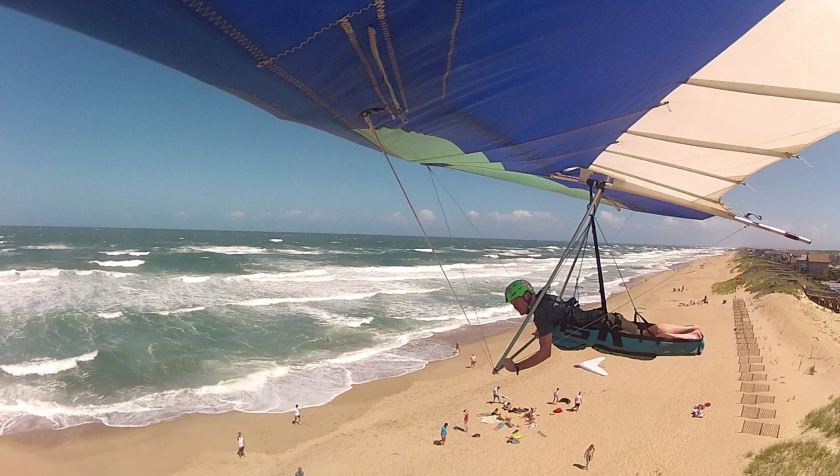 You can’t see the air–you can only see what it does. You can see it move sand, create waves, even lift leaves from the ground occasionally. But you can feel it. Hold your hand out the window of your car and feel the force of textured air at 50 miles an hour. Stand on a mountain top in winter and feel the air flow by, milk-thick and smooth.
 rogismycopilot